
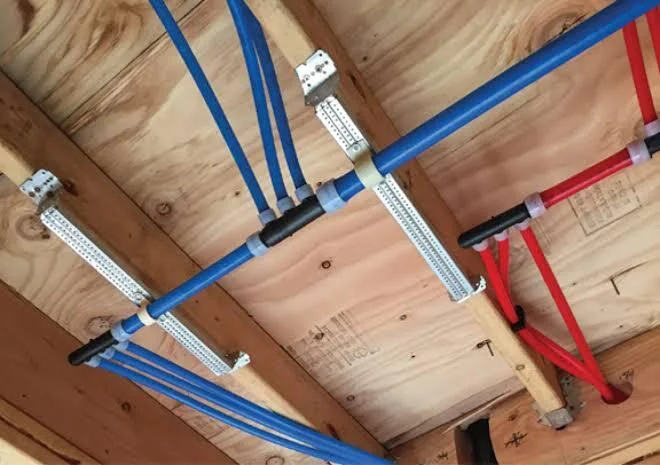
PEX plumbing is a flexible water-supply piping system made from crosslinked polyethylene. It is commonly used for hot- and cold-water lines in homes because it can bend around obstacles, requires fewer fittings in some layouts, and does not corrode like metal pipe.
But whether PEX is a good choice for your house depends on more than the tubing itself. The fittings, connections, installation quality, system design, existing plumbing and where the pipe is installed all matter.
Quick answer: PEX, or crosslinked polyethylene, is flexible plastic tubing used for residential water-supply plumbing. It is corrosion-resistant, easier to route than rigid pipe and commonly used for repairs and repiping. Most PEX problems involve installation, fittings, damage or unsuitable conditions rather than the material alone.
What Is PEX Plumbing?
PEX stands for crosslinked polyethylene. Crosslinking changes the molecular structure of polyethylene, giving the material properties suitable for pressure piping and hot- and cold-water plumbing applications.
In a house, you may see PEX running from a water heater, through a crawl space, behind walls, or from a central manifold to individual fixtures. It is available in different colors, commonly red, blue and white, although color alone does not determine the type or performance of the tubing.
PEX became popular largely because it is flexible. Copper and CPVC are rigid, so changing direction usually requires fittings. PEX can bend through framing and around obstacles within the manufacturer’s permitted bend radius, which can reduce the number of connections needed in some installations.
That flexibility can be especially useful during renovations and repiping projects where opening large sections of finished walls would otherwise be required.
How Does PEX Plumbing Work?
PEX carries water in much the same way as other residential supply piping. The major difference is how the system is routed and connected.
PEX tubing connects to fixtures, valves and other pipe using compatible fittings and an approved joining system. Depending on the particular PEX system, plumbers may use crimp rings, clamps or expansion-style connections.
A PEX system can be arranged like traditional branch plumbing, where a larger supply line branches into smaller fixture lines. Another option is a PEX manifold, which acts as a central distribution point with separate lines running toward individual fixtures or groups of fixtures.
Neither layout is automatically better. Pipe sizing, fitting selection, run length and fixture demand still have to be considered.
PEX can also transition to existing materials such as copper using an approved transition fitting. That means installing PEX does not automatically require removing every piece of copper plumbing in a house.
PEX-A vs PEX-B vs PEX-C: What Is the Difference?
One of the biggest misunderstandings about PEX is that A, B and C represent quality grades.
They do not.
They describe different methods used to crosslink polyethylene:
| Type | Manufacturing Method | Practical Difference |
|---|---|---|
| PEX-A | Peroxide method | Generally highly flexible and compatible with certain expansion systems |
| PEX-B | Silane method | Widely available and commonly used with several fitting systems |
| PEX-C | Electron-beam method | Produced through a different post-extrusion crosslinking process |
The Plastics Pipe Institute specifically notes that these letters are not a performance-rating system. PEX products made through the different methods must meet the applicable requirements of the standards under which they are manufactured and listed.
So asking whether PEX-A is “better” than PEX-B is usually the wrong question.
A better question is: Which tubing and connection system makes sense for this particular installation?
Flexibility, fitting system, available space, installer familiarity, manufacturer requirements and project design can all influence the answer.
What Are the Main Advantages of PEX Plumbing?
PEX has several practical benefits for residential plumbing.
Flexibility. The tubing can bend around many obstacles, which is useful in walls, floors, ceilings and crawl spaces.
Fewer connections in some layouts. Longer continuous runs can reduce the number of elbows and intermediate fittings compared with rigid piping.
No metal-pipe corrosion. PEX itself does not corrode in the way copper, steel or galvanized piping can.
Useful for renovations. Flexible pipe may be easier to route through an existing structure with less demolition.
Multiple system designs. PEX can be installed in conventional branch systems or manifold/home-run layouts.
Installation efficiency. Depending on the house and layout, its flexibility can reduce installation complexity.
Those advantages explain why PEX is widely considered for both individual pipe repairs and larger repiping projects. They do not mean it is automatically the right material for every part of every home.
Why Do People Say PEX Plumbing Is Bad?
Search for PEX online and you will find homeowners asking, “Why is PEX plumbing bad?”
Usually, the concerns fall into a few specific categories rather than one universal defect.
PEX is sensitive to prolonged ultraviolet exposure. ASTM’s outdoor-weathering guidance states that PEX tubing is not designed for outdoor use, so sunlight exposure and manufacturer limits have to be taken seriously.
It can also be physically damaged. Nails, screws, sharp edges and other external forces can damage tubing. In accessible areas, rodents may also be a consideration.
Connections introduce another potential failure point. A perfectly serviceable length of PEX can still leak if a fitting is damaged, a connection was made incorrectly or incompatible components were used.
PEX also has application and temperature limits. Those limits depend on the specific listed product and system, so plumbers need to follow the manufacturer’s requirements rather than assuming every PEX product has identical ratings.
The real takeaway is not that “PEX is bad.” It is that PEX is a plumbing system, not simply a piece of plastic tubing. Material selection, fittings and workmanship all matter.
What Actually Causes PEX Plumbing Problems?
This is where diagnosing the system correctly becomes important.
Pipe failure
The tubing itself can be damaged by inappropriate exposure, excessive operating conditions, manufacturing or product-specific issues, or physical damage.
A leak in the middle of otherwise undisturbed tubing deserves a different investigation from a leak directly beside a fitting.
Fitting failure
PEX fittings can be made from different approved materials and come in several designs. A failed fitting does not necessarily mean the surrounding tubing is defective.
The fitting, its condition and compatibility with the rest of the system should be evaluated separately.
Connection failure
A leak at a crimp, clamp or expansion connection may point to workmanship, incorrect tools, poor preparation, improper positioning or incompatible system components.
This is why the location of the leak matters.
Installation error
PEX still needs proper support, protection, sizing, bending and placement. Flexible does not mean installation rules can be ignored.
Poorly planned routing can also make future access and repairs unnecessarily difficult.
External damage
Construction screws, nails, abrasion, heat sources, UV exposure and other external conditions can damage otherwise sound tubing.
Incorrect application
A product that works well in one plumbing application may be unsuitable somewhere else.
PEX installation should comply with the currently adopted South Carolina plumbing code, applicable local requirements, manufacturer instructions and the standards applying to that particular product.
As of October 2026, South Carolina’s 2024 building-code cycle is scheduled to become effective January 1, 2027, so installers should always confirm the code actually in effect when the work is performed.
How Long Does PEX Plumbing Last?
There is no responsible way to promise that every PEX plumbing system will last an exact number of years.
PEX has decades of real-world use, and applicable industry standards include extensive long-term performance testing. But laboratory testing should not be confused with a guaranteed lifespan inside a particular house.
ASTM specifically notes that real-world performance can be affected by installation methods, water conditions, operating temperatures, pressure, localized stresses and how the system is used.
In practice, the condition of the system matters more than choosing an arbitrary replacement date.
If your PEX has no signs of leakage or deterioration, one number on the calendar is not a reason to repipe the house. If you are experiencing repeated failures in multiple areas, the overall system deserves a closer look.
Can PEX Freeze or Burst?
PEX can perform better than some rigid piping during freezing conditions because the tubing has flexibility, but PEX is not freeze-proof.
Industry installation guidance specifically warns that PEX systems should not intentionally be subjected to freezing even though the tubing can have greater resistance to freeze-related breakage.
Pipes in vulnerable areas still need proper freeze protection.
That matters in Charleston too. Severe freezing temperatures are less common than in northern states, but occasional cold snaps can still affect exposed plumbing, especially in crawl spaces and exterior areas.
Is PEX Safe for Drinking Water?
PEX intended for potable-water use should carry the appropriate certifications and be installed as part of an approved plumbing system.
NSF/ANSI/CAN 61 establishes health-effects requirements for materials and components that come into contact with drinking water, including piping-related products. NSF also certifies PEX and other plastic piping components under applicable standards.
For a homeowner, the practical rule is simple: use properly listed products, compatible components and correct installation practices rather than unverified tubing or fittings.
PEX vs Copper: Which Is Better?
There is no universal winner between PEX and copper.
| Factor | PEX | Copper |
|---|---|---|
| Flexibility | Highly flexible | Rigid |
| Connections | Can require fewer fittings in some layouts | Direction changes generally require fittings |
| Corrosion | Does not corrode like metal | Can be affected by corrosion and water conditions |
| UV exposure | Requires protection | Not affected in the same way |
| Physical damage | Can be cut or punctured | More resistant to some physical damage |
| Routing | Useful through tight or difficult spaces | More difficult through finished structures |
| Repairs | Often straightforward with compatible fittings | Well-established repair methods |
| Existing system | Easy to transition in many situations | May make sense where existing copper remains sound |
| Material choice | Product and system dependent | Familiar, durable traditional option |
If your house already has copper that remains in good condition, replacing it simply because PEX exists may make little sense.
For more detail on evaluating an existing copper system, see our guide to how long copper plumbing lasts.
When Does PEX Make Sense for Repiping?
PEX becomes especially worth considering when a house has widespread aging or deteriorated supply piping, repeated failures in different locations, major renovation work, or old piping that is difficult to repair economically.
It can also make routing new water lines easier in houses with crawl spaces, complicated framing or limited access.
But repeated failures are different from one isolated problem.
If one fitting is leaking and the rest of the system is healthy, a localized PEX pipe repair may be all that is needed.
If you are unsure whether you are looking at a repair problem or a system-wide problem, Pineapple Plumbing can inspect the piping, determine where the failure is occurring and explain both options before you commit to larger work.
Does One PEX Leak Mean You Need to Repipe the Whole House?
No, not automatically.
One leak may be caused by a single damaged fitting, installation issue or isolated section of tubing.
The more important question is whether there is a pattern.
Multiple leaks in unrelated parts of the system, recurring connection failures, visibly damaged piping or a known problematic installation may justify a broader evaluation.
Otherwise, replacing an entire plumbing system because of one repairable leak can be unnecessary.
That repair-first approach is also why proper leak detection and pipe repair should come before assuming the worst.
Is PEX a Good Choice for Charleston Homes?
PEX can be a practical option for many Charleston-area homes, but the decision should start with the house rather than the material.
Older Lowcountry homes may contain several generations of plumbing. It is not unusual for renovations and past repairs to leave a combination of copper, galvanized piping and newer materials.
PEX can be useful when replacing deteriorated supply lines, routing plumbing through crawl spaces, remodeling kitchens or bathrooms, or connecting new sections to existing plumbing that remains in good condition.
It can also reduce the need for extensive opening of walls in certain repiping projects because flexible tubing can often be routed more easily than rigid materials.
But a Charleston house with one leaking copper joint does not automatically need a PEX repipe. Likewise, a house experiencing repeated failures throughout an aging plumbing system should not be treated as a collection of unrelated leaks forever.
A plumbing inspection can help determine which situation you actually have.
When Should You Call a Plumber About PEX?
Use the pattern and severity of the problem as your guide.
| Situation | What It May Mean | Best Next Step |
|---|---|---|
| No leaks or visible damage | System may be functioning normally | Monitor |
| One minor isolated leak | Local fitting or pipe problem | Schedule a repair |
| Unknown plumbing history | Condition is uncertain | Schedule an inspection |
| Recurring fitting leaks | Installation or system issue may exist | Have the system evaluated |
| Multiple leaks in different locations | Broader deterioration or installation problem | Consider a repiping evaluation |
| Significant low-pressure or flow concerns | Could involve sizing, restriction or another plumbing issue | Diagnose before replacing pipe |
| Major active leak | Immediate water-damage risk | Shut off water and call for repair |
If something appears wrong but you do not know whether the issue is PEX, a fitting or another part of the plumbing system, proper diagnosis should come before replacement. Pineapple Plumbing provides general plumbing repairs throughout Charleston and the surrounding Lowcountry.
The Bottom Line on PEX Plumbing
PEX can be an excellent residential plumbing material when the right product is installed correctly for the right application.
Its biggest advantages are flexibility, corrosion resistance and installation versatility. Its weaknesses include UV sensitivity, susceptibility to physical damage and dependence on correct fittings and workmanship.
Most importantly, a leak somewhere in a PEX system does not prove the entire system is bad.
If you are dealing with recurring leaks, failing fittings, aging pipes or an unknown mix of plumbing materials, Pineapple Plumbing can inspect the system, identify what is actually failing and explain whether a targeted repair or broader repiping project makes more sense for your Charleston home.
Frequently Asked Questions About PEX Plumbing
What is PEX plumbing?
PEX plumbing uses flexible crosslinked polyethylene tubing to carry hot and cold water through a building. It is widely used for residential supply piping, repairs, renovations and whole-house repiping.
How long does PEX plumbing last?
PEX is designed and tested for long-term plumbing use, but there is no guaranteed lifespan for every installation. Actual service life depends on the product, installation, fittings, operating conditions, water conditions, UV exposure and physical damage.
Why do people say PEX plumbing is bad?
Concerns usually involve UV exposure, damaged tubing, poor connections, fitting failures or improper installation. These problems should be diagnosed individually rather than assuming every failure means PEX itself is defective.
Is PEX-A better than PEX-B?
Not automatically. PEX-A and PEX-B describe different manufacturing processes, not first- and second-place quality grades. Both can be suitable when the product meets applicable standards and is correctly selected and installed.
Is PEX better than copper?
It depends on the project. PEX provides flexibility, corrosion resistance and easier routing, while copper offers rigidity, long-established installation methods and advantages in some applications. Existing plumbing condition should influence the decision.
Can PEX freeze?
Yes. PEX may tolerate expansion from freezing better than some rigid materials, but it is not freeze-proof. Vulnerable water lines still need proper protection from freezing temperatures.
Can PEX connect to existing copper plumbing?
Yes. Approved transition fittings can connect PEX to existing copper, allowing plumbers to repair or replace sections without automatically removing every sound copper line in the house.
Should I repipe my house with PEX after one leak?
Usually not based on one leak alone. First determine whether the failure involves one fitting or section of tubing. Repeated failures in different areas are a stronger reason to evaluate the entire plumbing system.


