
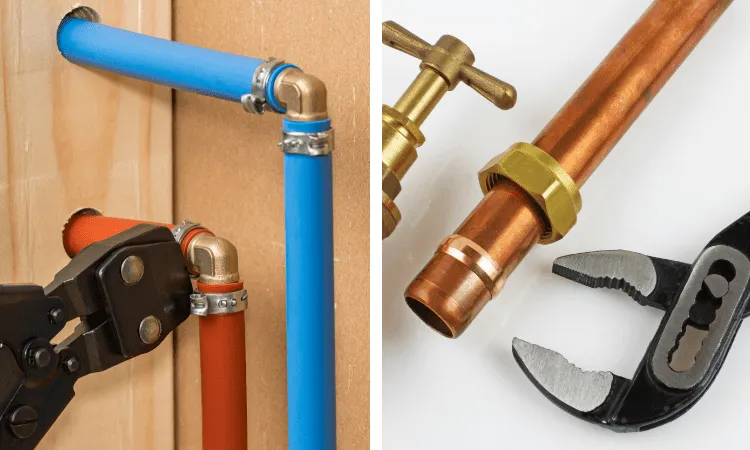
PEX is generally the more affordable and easier-to-install option for residential repiping, while copper offers proven durability, greater rigidity and advantages in certain exposed or high-temperature applications. Both can provide reliable water supply plumbing when the right products are installed correctly. The better choice depends on your home’s plumbing condition, layout, budget and the work you actually need done.
For Charleston homeowners, there’s another question worth asking before comparing materials: Do you need to replace your existing pipes at all?
A single copper leak doesn’t automatically mean you need a whole-house repipe. Likewise, choosing PEX instead of copper won’t necessarily solve low water pressure, poor pipe sizing or a plumbing problem that hasn’t been properly diagnosed.
Here’s how the two materials compare, where each makes sense, and what you should know before approving a plumbing repair or replacement estimate.
PEX vs Copper Plumbing: At a Glance
PEX (cross-linked polyethylene) is flexible plastic tubing used for hot- and cold-water supply lines. Copper is a rigid metal pipe with decades of residential plumbing use. Both are established options for household water distribution, although they require different fittings, tools and installation methods.
| Factor | PEX Plumbing | Copper Plumbing |
|---|---|---|
| Material cost | Generally lower | Generally higher |
| Installation | Flexible, often easier to route through existing homes | Rigid, generally requires more fittings and labor |
| Lifespan | Designed for long-term service; actual life varies | Decades of service possible; affected by water and installation conditions |
| Corrosion | Does not experience metal corrosion | Can develop internal corrosion or pinhole leaks |
| Freezing | More flexible, but not freeze-proof | Rigid and vulnerable to freezing damage |
| Sunlight exposure | Requires protection from UV | Better suited to exposed applications where appropriate |
| Connections | Crimp, clamp or expansion systems, depending on product | Soldered, pressed or approved mechanical connections |
| Common advantages | Renovations, difficult routing and extensive repiping | Rigid fixture connections, exposed installations and suitable long-term systems |
The important distinction: PEX is not automatically better because it’s newer, and copper is not automatically better because it’s metal. The quality of the installation matters as much as the material.
PEX vs Copper Cost: Which Is Cheaper to Install?
For most residential projects, PEX has a cost advantage. The tubing generally costs less than copper, and its flexibility can reduce the number of fittings and the labor required to route pipes through an existing house.
As a national material-cost reference, Angi’s August 2026 comparison lists PEX at approximately $0.50–$2 per linear foot and copper at approximately $2–$8 per linear foot. These are broad material estimates, not installed prices or verified Charleston plumbing quotes. Actual costs depend on pipe size, type, supplier and project requirements.
The difference in the completed bill can be much larger or smaller than the tubing-price difference suggests.
Consider a home where supply lines must pass through several finished walls. Flexible PEX may allow longer continuous runs with fewer openings. Copper generally requires more individual pieces and connections when the route changes direction. Labor and restoration costs could therefore make PEX considerably more attractive.
But if you’re replacing one short, accessible copper section under a sink, matching the existing copper may be more sensible than introducing another material.
What Actually Determines Your Repiping Cost?
The material is only one part of the estimate. The total price also depends on how much piping needs replacement, the number of fixtures being connected, access through walls or crawl spaces, fittings and valves, permits, testing and any required drywall or flooring restoration.
This is why a whole-house copper-versus-PEX comparison should use complete, itemized installation estimates, not just prices per foot.
A lower quote isn’t necessarily a better deal if it excludes work that another contractor has included.
Which Lasts Longer: PEX or Copper?
Copper has the longer established track record in American residential plumbing. Well-installed copper supply lines can serve a home for many decades, but their condition is influenced by water chemistry, pressure, installation quality and other factors.
Consumer estimates commonly place copper plumbing in the 50–70-year range, although some systems fail sooner and others last longer. If your pipes are approaching that age, it doesn’t automatically mean they need replacing.
PEX is also engineered for long-term use. The Plastics Pipe Institute explains that potable-water PEX must meet long-term performance requirements, including testing used to evaluate resistance to chlorinated water under specified operating conditions.
Those tests use extrapolated service-life calculations, but a 50-year testing requirement is not a guarantee that every installed PEX system will last exactly 50 years.
Both materials can fail prematurely when installed incorrectly or used in unsuitable conditions. A copper system may develop corrosion-related pinholes, while a PEX installation could experience problems involving unsuitable fittings, UV exposure, physical damage or incorrect product selection.
For homeowners, the better question isn’t simply which pipe can last longer. It’s which material is appropriate for the actual water conditions, operating requirements and installation in your house.
For more information about evaluating older copper lines, see our guide on how long copper plumbing lasts.
PEX vs Copper Durability: What Can Actually Go Wrong?
Both materials have advantages, but neither eliminates the possibility of plumbing leaks.
Copper: Corrosion and Pinhole Leaks
Copper is strong, rigid and resistant to many forms of physical damage. However, it can corrode internally under certain conditions.
Water chemistry, excessive flow velocity, turbulence and poor installation practices can contribute to corrosion problems. Over time, localized pitting may penetrate the pipe wall, causing a pinhole leak.
The Copper Development Association’s technical guidance identifies aggressive water conditions and installation-related factors among potential causes of copper corrosion.
One pinhole leak doesn’t establish that every pipe in the house is deteriorating. Repeated leaks in different sections, however, are a good reason to investigate the larger system rather than continuing to repair individual failures without understanding their cause.
PEX: Fittings, Physical Damage and UV Exposure
PEX doesn’t rust or develop the same corrosion-related pinholes as copper, but that doesn’t mean PEX plumbing is immune to problems.
Leaks can occur when fittings are incompatible, connections are poorly installed, tubing is damaged or the piping is used outside its approved operating conditions.
PEX also requires protection from sunlight and UV exposure. Product-specific limits apply, including restrictions on storage and installation exposure.
PEX-A and PEX-B describe different manufacturing methods, not first- and second-place quality grades. The selected system, its fittings and the manufacturer’s installation requirements matter more than treating one label as universally superior.
For homeowners weighing reliability, ask the plumber which tubing and joining system they plan to use, and whether the components are compatible and properly rated for the application.
Is PEX Better Than Copper in Freezing Weather?
PEX’s flexibility may allow it to tolerate some freezing expansion better than rigid copper. That advantage can be useful during the occasional cold snap in the Lowcountry, especially in vulnerable locations such as crawl spaces.
But PEX is not freeze-proof. Fittings can still be damaged, and frozen tubing may fail if it cannot expand sufficiently.
Neither material removes the need for proper pipe routing, insulation and protection from freezing temperatures.
Does PEX Reduce Water Pressure Compared With Copper?
This is one of the most misunderstood parts of the comparison.
Homeowners sometimes hear that PEX reduces water pressure because its interior diameter can differ from copper of the same nominal size, and some PEX fittings restrict the opening further.
There is a distinction between water pressure and water flow. Static water pressure is the pressure available when water isn’t moving. Flow rate describes how much water reaches a fixture while it’s being used.
Pipe diameter, run length, fittings, fixture demand and system layout all affect the results.
For example, a long run supplying several bathrooms needs to be sized for the expected demand. Replacing it with undersized PEX could restrict flow, but installing appropriately sized PEX with a sound layout may provide excellent performance.
Copper isn’t automatically the answer to every weak shower, either. A clogged aerator, failing pressure regulator, restrictive valve or corroded old supply line could be responsible.
Before approving repiping to fix poor flow, have the underlying problem identified. The Plastics Pipe Institute’s 2026 PEX design guide provides technical guidance on system design and installation.
Is PEX or Copper Safer for Drinking Water?
Both materials can be suitable for potable-water plumbing when correctly selected and installed.
Copper is widely used for drinking-water systems, but corrosive conditions can increase the amount of copper released into water. PEX avoids metal corrosion, although plastic plumbing products must also be evaluated for substances that could migrate into drinking water.
That’s why product certification matters.
NSF/ANSI/CAN 61 establishes health-effects requirements for drinking-water system components, including pipes and fittings.
For either material, homeowners should look for appropriately certified products and installation that follows current plumbing requirements.
If you’re concerned about water quality in Charleston, review the Charleston Water System’s water quality reports. Water supplied by the utility and water conditions at an individual faucet are not always identical because the home’s own plumbing also influences water quality.
Which Is Better for Older Charleston Homes?
Charleston and the surrounding Lowcountry have a wide variety of housing, from historic downtown properties to raised homes with crawl spaces and newer construction in Summerville and Mount Pleasant.
That variety matters when choosing plumbing materials.
Older Homes With Existing Copper Pipes
An older Charleston or West Ashley home may have copper supply lines that have been repaired or extended over the years. If most of the copper is in good condition, replacing everything with PEX may be unnecessary.
On the other hand, repeated leaks in different areas, widespread deterioration or extensive remodeling may make broader replacement worth considering.
The priority should be identifying why the existing system is failing, rather than assuming age alone determines the answer.
Raised Homes and Crawl-Space Plumbing
Many Lowcountry homes have supply lines routed through accessible crawl spaces. This can make certain repairs and replacements less disruptive than work inside finished walls.
PEX’s flexibility may make routing through joists and around obstacles easier. Copper may still be appropriate where rigid connections or other installation requirements favor it.
Moisture, pipe supports, physical protection and accessibility should be considered regardless of the material.
Slab Foundations and Difficult-to-Access Pipes
If a water line beneath a concrete slab develops a leak, replacing the failed section in place may involve substantial access work.
Depending on the home’s layout, rerouting a replacement supply line through a different approved path can sometimes be less disruptive.
Pineapple Plumbing discusses this approach on its leak detection and pipe repair page. Whether PEX or copper is preferable depends on the routing and installation requirements.
For plumbing work in South Carolina, the applicable code also matters. As of October 2026, the state is operating under its 2021 code cycle, with the 2024 code cycle scheduled to take effect on January 1, 2027. Your plumber should verify the current requirements, permits and inspections for the project.
Should You Replace Existing Copper Pipes With PEX?
Not necessarily. If the existing copper system is sound and functioning properly, there may be no practical benefit in replacing it simply because PEX is available.
Consider these common situations:
| Your Plumbing Situation | What Usually Makes Sense |
|---|---|
| Copper pipes are working with no recurring problems | Keep and monitor the existing system |
| One accessible copper fitting or pipe section leaks | Investigate and consider a targeted repair |
| Several copper lines develop repeated leaks | Evaluate the whole system and possible repiping |
| A renovation requires extensive new water lines | Compare PEX and copper based on routing, access and cost |
| Existing supply lines have widespread corrosion | Assess replacement scope and material options |
| Part of the system needs replacing while the rest is sound | Consider partial replacement with approved transitions |
A combination of materials can also make sense. PEX may serve longer concealed supply runs, while copper or other approved rigid materials may be preferable for particular exposed connections or fixture applications.
Approved transition fittings allow PEX to connect with copper. The details depend on the products, fixture specifications and applicable plumbing code.
Repair vs Repiping: What Matters Most?
Before agreeing to a whole-house repipe, ask whether the problem involves an isolated failure or a larger pattern.
If one connection fails but the surrounding piping is healthy, a localized repair may be enough.
If leaks repeatedly appear throughout the system, multiple sections show deterioration or the cost of continued repairs is becoming unreasonable, a more comprehensive evaluation is justified.
A professional plumbing inspection can help establish what materials are present, whether other sections show warning signs and which replacement options deserve consideration.
How to Compare PEX and Copper Repiping Quotes
Homeowners sometimes receive one estimate recommending PEX and another recommending copper. Those quotes may reflect different installation approaches, not simply different material prices.
Before choosing, compare the actual work included.
1. What piping is being replaced? Confirm whether the estimate covers every hot- and cold-water supply line, selected branches or only visibly damaged sections. Ask what existing piping will remain.
2. What products and connections will be used? For PEX, ask about the tubing manufacturer and compatible fitting system. For copper, ask about the proposed pipe type and joining methods. Confirm that the products are approved for their intended locations.
3. Is everything properly sized? The quote should account for fixture demand and system layout. A cheaper installation shouldn’t come at the expense of adequate water flow.
4. What access and restoration work is included? Clarify who handles wall openings, flooring access, patching, cleanup and any restoration that follows the plumbing installation.
5. Are permits, inspections and testing included? Confirm which requirements apply and whether the contractor is handling them. Ask how the new system will be tested before concealed areas are closed.
6. What warranties apply? Understand the difference between the manufacturer’s product warranty and the contractor’s workmanship warranty, including any exclusions.
Getting these answers in writing makes comparing plumbing estimates much easier.
So, Is PEX or Copper the Better Choice?
For many Charleston homeowners planning extensive residential repiping, PEX is a practical option because it typically costs less and can be easier to install through an existing house.
Copper remains a sound choice where its rigidity, exposure resistance, application suitability or the homeowner’s preferences justify the additional expense.
But the right material is only part of the decision. A well-designed, correctly installed plumbing system is more valuable than an expensive material used poorly.
And if your existing copper pipes are still in good condition, the best choice may be to leave them alone.
Frequently Asked Questions About PEX vs Copper Plumbing
Is PEX plumbing better than copper?
PEX is often more economical and easier to route during residential repiping, while copper provides rigidity and advantages in certain exposed or specialized applications. Neither is universally better. The right choice depends on your home’s conditions and the plumbing project.
Does PEX last as long as copper?
Both are intended for long-term plumbing service, but copper has a longer established residential track record. Actual lifespan depends on water conditions, product selection, installation and maintenance. Neither material comes with a universal service-life guarantee.
Is PEX cheaper than copper plumbing?
Generally, yes. PEX tubing costs less and may require less installation labor, especially when replacing long runs through existing walls. However, a complete repiping estimate also includes fittings, access work, testing and potentially restoration costs.
Can you replace copper pipes with PEX?
Yes. Approved fittings can connect PEX to existing copper, making both partial replacements and whole-house conversions possible. The installation must use compatible components and meet applicable code and manufacturer requirements.
Does PEX reduce shower water pressure?
Not automatically. An undersized or poorly designed PEX system can restrict flow, but correctly sized tubing can deliver appropriate water flow. Existing water pressure, pipe length, fitting restrictions and fixture demand also matter.
Is copper more reliable than PEX?
Both can be reliable. Copper may experience corrosion or pinhole leaks under certain conditions, while PEX can be affected by unsuitable fittings, installation errors, UV exposure or physical damage. Proper material selection and workmanship are essential for either system.
Should I repipe my entire house after one copper leak?
Usually, one isolated leak isn’t enough reason to replace an otherwise sound plumbing system. Repeated failures, widespread corrosion or multiple deteriorated sections provide stronger reasons to evaluate whole-house repiping.
Can a house have both PEX and copper plumbing?
Yes. Many plumbing systems can incorporate both materials using approved transition connections. A combination may be appropriate when replacing one section, remodeling a bathroom or preserving sound existing copper while installing new supply lines.
Need Help Choosing Between PEX and Copper in Charleston?
If you’re dealing with recurring pipe leaks, aging copper lines, low water flow or a proposed whole-house repipe, the first step should be understanding the condition of your existing plumbing.
At Pineapple Plumbing, we believe in diagnosing the actual problem before recommending major work. Sometimes a targeted repair makes sense. Other times, replacing deteriorated supply lines is the better long-term decision.
Our team serves Charleston, Summerville, Mount Pleasant, West Ashley, North Charleston and surrounding Lowcountry communities.
Whether you’re considering PEX, copper or simply wondering whether your existing pipes need attention, we can help you understand your options.
Contact Pineapple Plumbing to discuss your plumbing concerns and find out which repair or replacement approach makes sense for your home.


