Here’s a scenario we hear about more than we’d like: a homeowner in West Ashley gets a suspiciously low quote over the phone from someone who found them on a Facebook ad. The guy shows up, no shoe covers, no license number on the truck, and says he’ll need full payment upfront before ordering parts. Three weeks later, the “repair” is leaking again, and the phone number is disconnected.
It happens. And it happens more in markets like Charleston, where the demand for plumbers is high, the housing stock is complicated, and there’s no shortage of people willing to take your money without the credentials to back up the work.
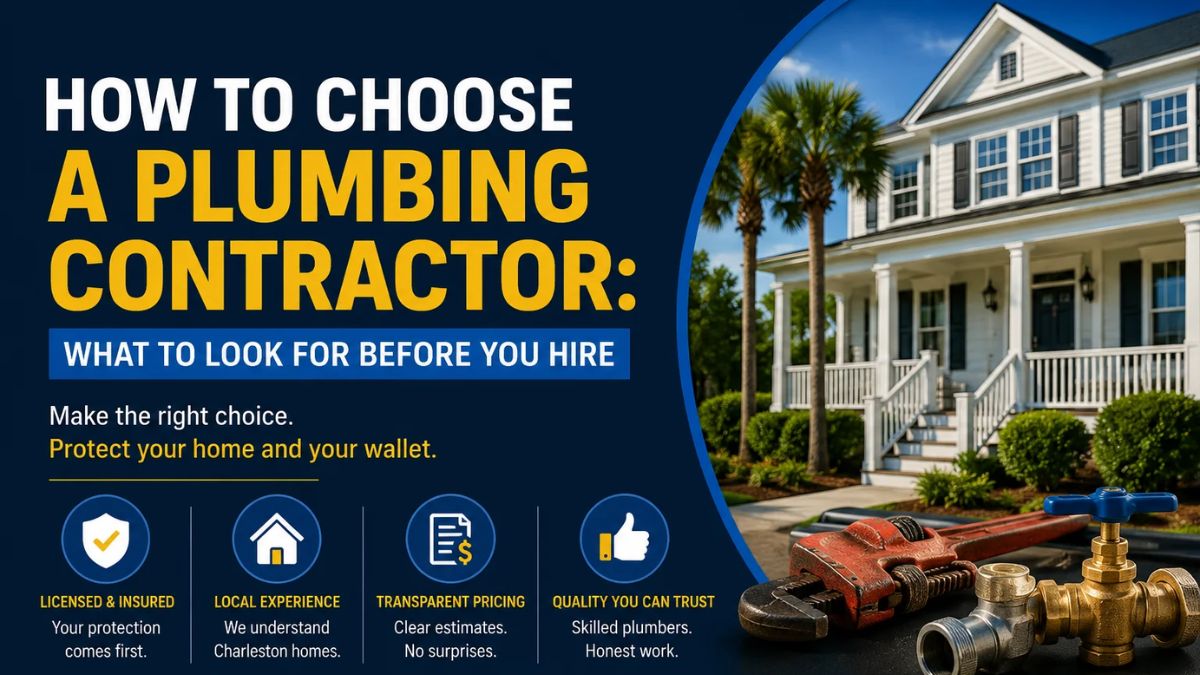
Choosing the right plumbing contractor isn’t just about price. It’s about protecting your home, your wallet, and your time. Here’s what to look for, what to ask, and what should make you walk away.
Why Choosing the Right Plumbing Contractor Matters in Charleston
Charleston isn’t a straightforward market for plumbing. The Lowcountry throws challenges at plumbing systems that you won’t find in most other parts of the country, and a plumber who doesn’t understand those challenges can do more harm than good.
Coastal humidity accelerates corrosion on metal pipes and fittings, especially in crawl spaces where moisture sits year-round. Salt air near the coast eats through outdoor fixtures and connections faster than inland areas. Homes built before the 1960s, particularly in downtown Charleston and parts of West Ashley, often still have galvanized steel supply lines and cast iron drain pipes that require specific knowledge to work on safely. Homes built in the 1980s and early 1990s across Summerville, Goose Creek, and North Charleston may contain polybutylene pipes that are prone to sudden failure.
On top of all that, the Historic District has its own permitting requirements for exterior plumbing modifications, and hurricane season adds urgency to storm preparation work every year.
A plumber from out of the area might know how to sweat a copper joint, but if they don’t know what’s behind the walls of a 1940s single house or how Charleston’s flat terrain affects drainage, you’re paying for guesswork. That’s why local experience isn’t just a nice-to-have here. It’s essential.
Check Licensing and Insurance First
In South Carolina, plumbing contractors are licensed through two state entities under the Department of Labor, Licensing and Regulation (LLR). Commercial plumbing work over $5,000 falls under the Contractor’s Licensing Board. Residential plumbing work over $500 requires a license through the Residential Builders Commission. Both are verifiable online through the LLR’s license lookup portal at verify.llronline.com.
Before hiring anyone, ask for their license number and look it up yourself. It takes two minutes. An active license means the plumber has passed the required examinations, met the experience requirements, and maintained their credentials. A plumber who hesitates to provide a license number, or who says they “don’t need one for this kind of work,” is someone you should pass on.
Insurance matters just as much. A plumbing contractor should carry general liability insurance and workers’ compensation coverage. If an uninsured plumber damages your property or gets injured on your job, you could be liable. Ask for proof of insurance before work begins. Any legitimate contractor will have it ready without hesitation.
Get a Written Estimate Before Any Work Begins
A trustworthy plumbing contractor gives you a written estimate that explains what work will be done, what materials are needed, and what it will cost, before they pick up a tool. Not a verbal ballpark. Not a “we’ll figure it out as we go.” A written number you can review, compare, and hold them to.
Here’s what to watch for:
Verbal-only quotes. If a plumber won’t put the price in writing, they’re leaving themselves room to change it after the work is done. Walk away.
Pressure to decide on the spot. A legitimate plumber won’t manufacture urgency to close a sale. If someone tells you the price is “only good today,” that’s a sales tactic, not a plumbing diagnosis.
Full payment demanded upfront. Deposits are reasonable for larger jobs involving equipment or materials. Full payment before work starts is not standard practice and leaves you with no leverage if the work is subpar.
Unusually low bids. If one quote comes in 40% below the others, something is missing: proper materials, licensed labor, insurance, or the intention to finish the job. The cheapest plumber is rarely the cheapest option in the long run.
Ask About Experience With Older and Historic Homes
This is where the gap between a good plumber and the right plumber for Charleston shows up most clearly.
The most common thing we see behind the walls of a pre-1960s Charleston home is galvanized steel supply lines that have corroded to the point where the internal diameter is a fraction of what it was originally. Homeowners call about low water pressure, and they’ve been told it’s the city’s supply or the pressure regulator. But once you open the wall, you can see the pipe is practically closed from the inside out. If a plumber doesn’t recognize that pattern, they’ll chase the wrong fix.
Cast iron drain lines in homes from the 1940s and 1950s present their own set of challenges. They’re heavy, they rust from the inside, and they crack at joints when they’ve been in service for 60 or 70 years. Working on them requires knowing how to cut, support, and transition to modern materials without damaging the surrounding structure.
If the home you’re calling about was built before 1980, ask the plumber directly: “Have you worked on galvanized supply lines and cast iron drains before?” Their answer, and the specificity of it, tells you a lot.
Read Reviews, But Know What to Look For
Star ratings are a starting point, not the whole picture. A company with 200 five-star reviews is impressive until you notice they all say the same thing in slightly different words. Here’s what actually matters when you’re reading plumbing reviews:
Consistency across different types of jobs. Look for reviews that mention specific work: toilet replacements, water heater installs, drain cleaning, emergency calls. A company that gets praised across multiple service types is more likely to be genuinely good than one with reviews that all sound templated.
How they handle complaints. Every company gets a negative review eventually. What matters is the response. Did they acknowledge the issue? Did they offer to make it right? A thoughtful response to a complaint tells you more about a company’s character than fifty five-star reviews.
Mentions of pricing transparency. Reviews that specifically say “they told us the price before starting” or “no surprise charges” are a green flag. That’s the kind of detail a real customer notices and a fake review doesn’t bother including.
Local specificity. Reviews that mention neighborhoods (Mount Pleasant, James Island, Summerville) or specific situations (crawl space repair, older home, emergency call) are almost always genuine. Generic one-liners are less reliable.
Confirm Emergency Availability and Response Time
Not every plumber offers emergency service, and not every “24/7” claim means someone actually answers the phone at 2 AM. Before you need an emergency plumber, know who you’d call.
Ask specifically: “If I have a burst pipe on a Sunday night, what happens when I call your number?” The answer should be clear: a real person answers or calls back within minutes, they walk you through shutting off the water, and they dispatch a plumber to your home. If the answer is vague or routes to a third-party answering service with no timeline, keep looking.
True plumbing emergencies include burst or broken pipes with active water flow, sewage backing up into the home, no water throughout the house, a water heater leaking heavily, or the smell of gas near a plumbing appliance. A slow drain or a dripping faucet can wait until normal business hours. A good emergency plumber will tell you that honestly rather than charging you an after-hours rate for something that isn’t urgent.
Red Flags That Should Make You Walk Away
Not every plumber who shows up at your door is someone you should let in. Here are the warning signs:
| Red Flag | What It Means |
| Won’t provide a license number | They may not have one |
| Demands cash-only payment | No paper trail, no recourse for you |
| Gives a quote without looking at the problem | They’re guessing, or they plan to “find” more work once they start |
| Pressures you into immediate, expensive repairs | Manufactured urgency is a sales strategy, not a diagnosis |
| No local address, no local reviews | Fly-by-night operations don’t stick around to warranty their work |
| Subcontracts everything through a dispatch network | The person quoting the job isn’t the person doing the work |
| No written estimate offered | They want room to change the price later |
| Shows up in an unmarked vehicle with no ID | Legitimate companies brand their trucks and identify their techs |
If you encounter more than one of these, find someone else.
Questions to Ask Before You Hire a Plumbing Contractor
Keep this list handy when you’re calling around. These questions separate the professionals from the ones who aren’t worth the risk.
- Are you licensed in South Carolina, and can I have your license number to verify?
- Do you carry general liability and workers’ compensation insurance?
- Will you provide a written estimate before starting work?
- Have you worked on homes with galvanized steel, cast iron, or polybutylene plumbing systems before?
- What does your warranty or satisfaction guarantee cover?
- Who actually shows up to do the work? Is it you, or a subcontractor?
- What’s your availability for emergencies, and what does that process look like?
The way a contractor answers these questions matters as much as the answers themselves. Someone who’s confident, specific, and unhesitant is usually someone who has nothing to hide.
Advice from Local Charleston Plumbers
Our team has worked on plumbing systems throughout Charleston and the surrounding Lowcountry for more than two decades. We’ve repaired aging galvanized pipes in historic homes, replaced failing polybutylene systems, installed water heaters, and responded to emergency plumbing calls across the region. The recommendations in this guide come from real-world experience helping local homeowners choose qualified plumbing contractors.
Frequently Asked Questions
How much does a plumbing contractor charge in Charleston, SC?
Most plumbing contractors in the Charleston area charge a service call fee (typically $50 to $150) plus the cost of the repair itself. Common repairs like faucet replacements, toilet repairs, and single-fixture drain cleaning generally fall between $150 and $500. Larger jobs like water heater replacement ($1,200 to $2,500 for tank units), sewer line work ($5,000 to $20,000+), and whole-home repiping ($4,000 to $15,000) vary significantly based on scope. Always get a written estimate before work begins so you know exactly what you’re paying.
Is it worth getting multiple plumbing quotes?
For non-emergency work, getting two or three quotes is a smart move. It gives you a sense of the fair price range for your specific job and helps you evaluate how each plumber communicates, diagnoses, and presents their recommendations. That said, the cheapest quote isn’t always the best value. A plumber who takes the time to explain the problem, provides a written estimate, and has strong local reviews is usually worth a modest premium over someone who quotes a low number without looking at the problem.
What’s the difference between a plumber and a plumbing contractor?
In practical terms for homeowners, the distinction matters less than credentials. A “plumber” is the individual tradesperson. A “plumbing contractor” is the licensed business entity authorized to perform and invoice for plumbing work. In South Carolina, residential plumbing work over $500 requires a license from the Residential Builders Commission, and commercial work over $5,000 requires licensing through the Contractor’s Licensing Board. What matters most is that whoever you hire holds the appropriate license, carries insurance, and can show you both before work begins.
How do I verify a plumber’s license in South Carolina?
Visit the South Carolina LLR (Department of Labor, Licensing and Regulation) online license verification portal at verify.llronline.com. You can search by the contractor’s name or license number. For residential plumbers, check the Residential Builders Commission lookup. For commercial contractors, check the Contractor’s Licensing Board lookup. The search takes about two minutes and shows you whether the license is active, suspended, or expired. If a plumber can’t or won’t give you a license number to look up, that tells you everything you need to know.
Should I hire a national franchise or a local plumbing company?
Both can do good work, but they operate differently. National franchises (Roto-Rooter, Mr. Rooter, Benjamin Franklin) have brand recognition and standardized processes, but the technician at your door is typically an employee following a corporate playbook. Local owner-operated companies tend to offer more personal service, and the person who answers the phone is often the person doing the work. In a market like Charleston, where older homes, coastal conditions, and local building quirks require specific knowledge, a plumber who lives and works in the community every day often has an edge.
What should I do if I’m not happy with a plumber’s work?
Start by calling the company directly and explaining the issue. A reputable contractor will come back and make it right. If they won’t, you have several options: file a complaint with the SC LLR Contractor’s Licensing Board (for licensed contractors), leave an honest review on Google to warn other homeowners, and contact the Better Business Bureau if the company is BBB-accredited. If the work caused property damage and the contractor is unresponsive, consult with a local attorney about your options. This is also why hiring a licensed, insured contractor matters in the first place: it gives you a regulatory body to escalate to.
Choosing a Plumber You’ll Actually Want to Call Again
The best time to find a good plumbing contractor is before you need one urgently. Do a little homework now, check a license, read some reviews, save a number in your phone, and you won’t be scrambling at midnight when a pipe breaks.
At Pineapple Plumbing, we built this company around the idea that hiring a plumber shouldn’t feel like a gamble. We’re locally owned by two Charleston-area plumbers with a combined 22 years of experience. We provide written estimates before any work begins. We don’t send salespeople to your door. And the person who quotes the job is usually the same person who shows up to do it.
If you’re looking for a plumbing contractor in the Charleston area, whether it’s for a routine repair, an older home that needs experienced eyes, or an emergency that can’t wait, give us a call at (843) 739-7438 or request service online. We’d rather earn your trust on a small job today than talk you into something you don’t need.
Pineapple Plumbing. Serving Charleston and the Lowcountry with honest work and Southern hospitality.


One Response