By Austin Holcomb & Austin Webb, Pineapple Plumbing | Summerville, SC
We get asked this question more than almost any other when a homeowner’s water heater dies: “Should I replace it with the same thing or switch to tankless?”
The honest answer is that both options are solid. Neither one is universally “better.” The right choice depends on your household size, your budget, what your home’s current setup can support, and how you use hot water. After 22 combined years of installing and repairing both types across Charleston, Summerville, Mount Pleasant, and the Lowcountry, here’s how we walk homeowners through the decision.
How They Work (and Why It Matters)
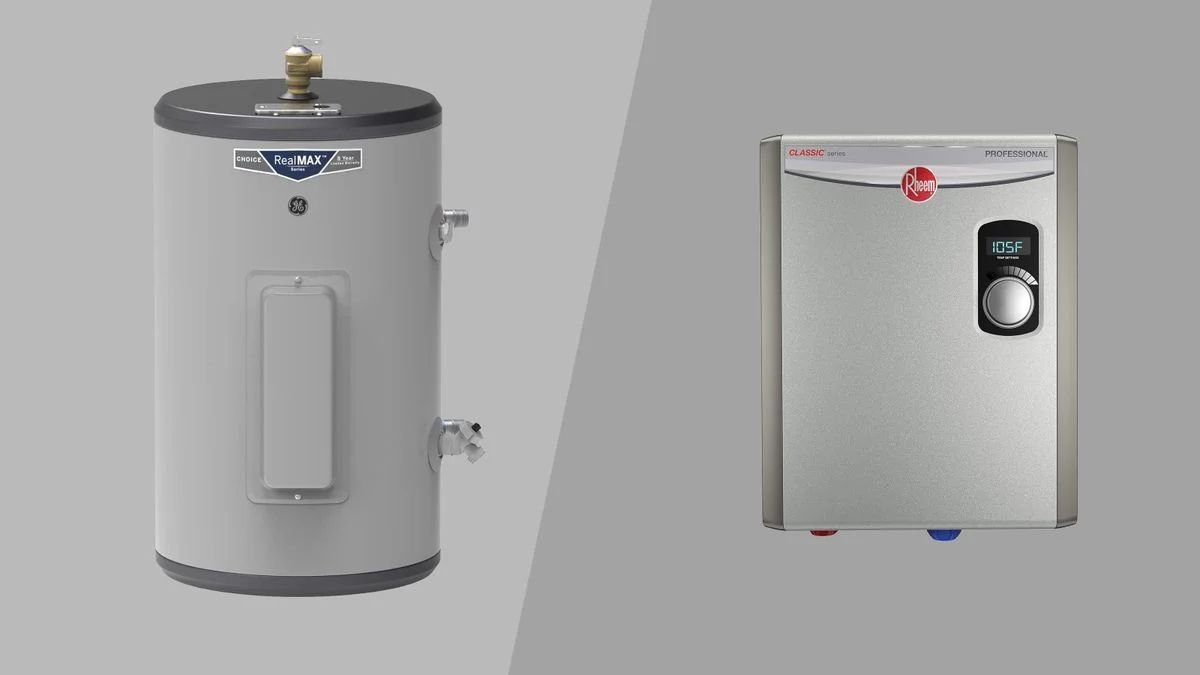
Tank water heaters store 40 to 50 gallons of preheated water in an insulated tank. A gas burner or electric element keeps that water hot around the clock, whether you’re using it or not. When you open a hot water faucet, heated water flows from the top of the tank while cold water enters the bottom to replace it.
Tankless water heaters don’t store anything. When you turn on a hot water faucet, cold water flows through a heat exchanger powered by a gas burner or electric element, and it comes out hot on the other side. The unit only fires when water is flowing.
The practical difference: a tank gives you a fixed supply that can run out during heavy use (back-to-back showers, laundry, and the dishwasher running simultaneously). A tankless unit never runs out because it heats water continuously, but it has a maximum flow rate (measured in gallons per minute) that limits how many fixtures it can serve at the same time.
The Side-by-Side Comparison
Here’s how the two types actually compare across the factors homeowners care about most:
Upfront cost. A standard 40 to 50 gallon tank water heater installed in the Charleston area typically runs $1,800 to $3,000, depending on fuel type and location. Tankless installations range from $3,000 to $6500 or more. The gap is larger if your home needs a gas line upgrade or a new dedicated electrical circuit to support a tankless unit.
Monthly operating cost. Tank heaters keep water hot 24 hours a day, even when nobody is home. That standby heat loss adds up. According to the U.S. Department of Energy, tankless water heaters can reduce energy costs by 24 to 34 percent for households that use 41 gallons or less of hot water daily. For higher-use households (86+ gallons daily), the savings are 8 to 14 percent. Either way, tankless costs less to operate per month.
Lifespan. Tank water heaters typically last 8 to 12 years with proper maintenance. Tankless units last 15 to 20 years or more, and many of their components are individually replaceable, extending the unit’s useful life even further.
Space. A tank water heater takes up significant floor space in a garage, closet, or crawl space. A tankless unit mounts on a wall and is roughly the size of a small suitcase. For Charleston’s older homes where mechanical space is limited, this can be a real advantage.
Hot water capacity. A 50-gallon tank delivers about 50 gallons before it needs time to recover. If your household runs through more than that in a short window (three showers, a load of laundry, and the dishwasher), you’ll notice the drop. A tankless unit delivers continuous hot water but is limited by flow rate. A standard whole-home gas tankless unit delivers 8 to 10 GPM, which is enough for two to three simultaneous fixtures in most cases.
Maintenance. Both types need annual maintenance. Tank heaters should be flushed annually to remove sediment, and the anode rod should be checked every few years. Tankless units need annual descaling to remove mineral buildup from the heat exchanger, especially in areas with harder water. Skipping maintenance on either type shortens its lifespan and reduces efficiency.
Why Charleston Actually Favors Tankless (More Than National Averages Suggest)
Most tank-vs-tankless comparisons online are written for a national audience. They don’t account for one factor that genuinely shifts the math for Lowcountry homeowners: our groundwater temperature.
In northern states, incoming cold water can enter the house at 40 degrees or lower during winter. A tankless unit has to raise that water’s temperature by 70 to 80 degrees to reach a comfortable 120 degrees. That takes serious energy and limits the unit’s effective flow rate.
In Charleston, our groundwater temperature ranges from about 55 degrees in winter to 75 degrees in summer. That means the tankless unit only needs to raise the temperature by 45 to 65 degrees, depending on the season. The result is better flow rates, less energy consumed per gallon heated, and lower monthly operating costs than the national DOE averages would predict.
Austin Webb has installed both types in homes from Summerville to James Island, and he’ll tell you the performance difference is noticeable. A tankless unit in the Lowcountry delivers more hot water per minute and uses less fuel per gallon than the same unit installed in a Chicago home. That’s not marketing. It’s physics.
When a Tank Water Heater Is Still the Right Call
Not every home benefits from switching to tankless, and we’re always honest about that. Here’s when a tank unit makes more sense:
You’re replacing with the same fuel type and setup. Swapping a tank for the same-sized tank is a straightforward job. Same location, same gas line or electrical connection, same venting. It can often be done in a few hours. Switching to tankless may require gas line modifications, electrical panel upgrades, or new venting, which adds cost and project time.
You have a large household with very high simultaneous demand. A family of six that runs three showers, the dishwasher, and the washing machine all at once may need a very high-capacity (or dual) tankless setup that pushes the installation cost well above what a properly sized large tank would cost.
When Tankless Is Worth the Higher Upfront Investment
You plan to stay in the home for 7+ years. The energy savings accumulate over time. The longer you own the home, the more the lower operating cost offsets the higher purchase price. Most homeowners see a payback period of 5 to 8 years, shorter in the Lowcountry thanks to our warm groundwater.
You’re tired of running out of hot water. If back-to-back showers are a daily occurrence and someone always ends up cold, a properly sized tankless unit solves that problem permanently.
You want to reclaim space. Removing a 50-gallon tank from a closet, garage corner, or crawl space and replacing it with a wall-mounted unit frees up real storage in a home where every square foot counts.
You’re concerned about water damage risk. A tank water heater holds 40 to 50 gallons of water. If the tank corrodes and fails, that water goes somewhere, usually onto your floor. A tankless unit holds virtually no water, which significantly reduces the flood risk from a failure. In Charleston’s humid climate, where water damage leads to mold faster than in drier areas, this is a practical consideration.
What the Switch from Tank to Tankless Actually Involves
If you’re replacing a tank with another tank, it’s a same-day job in most cases. Switching from tank to tankless takes more planning. Here’s what’s typically involved:
Gas line assessment. Tankless gas units require a higher BTU input than most tank heaters. If your existing gas line can’t supply enough volume, it may need to be upgraded. We assess this during the initial evaluation.
Venting. Gas tankless units require their own dedicated venting to the exterior. If your current tank uses a shared B-vent through the roof, the tankless unit will need a separate direct-vent or power-vent run. This is one of the most common cost variables in a tankless conversion.
Electrical (for electric tankless). Electric tankless units require a dedicated 240-volt circuit, and some require two. Your electrical panel needs available capacity to support it. If it doesn’t, a panel upgrade may be necessary.
Permits and code. South Carolina requires permits for water heater installations that involve gas line modifications, new venting, or electrical work. We handle the permit process as part of the project.
We walk you through all of this during the initial visit, before you commit to anything. If the conversion cost doesn’t make sense for your home, we’ll tell you. There’s nothing wrong with a quality tank water heater, and we install plenty of them.
Frequently Asked Questions
How much does a tankless water heater cost installed in Charleston?
Most whole-home gas tankless installations in the Charleston area run $3000 to $6500, depending on the unit, gas line requirements, and venting needs. Electric tankless units can cost less to purchase but may require electrical panel upgrades that offset the savings. A standard tank water heater replacement typically runs $1,800 to $3000 installed. We provide a written estimate that covers the full scope before any work starts.
How long does a tankless water heater last compared to a tank?
Tank water heaters typically last 8 to 12 years. Tankless units last 15 to 20 years or more with annual maintenance. Many tankless components (heat exchangers, burners, sensors) are individually replaceable, which means you can often extend the unit’s life even further without replacing the entire system.
Can a tankless water heater supply enough hot water for a large family?
Yes, if it’s properly sized. A standard whole-home gas tankless unit delivers 8 to 10 GPM, which handles two to three simultaneous fixtures comfortably. For very large households or homes with high simultaneous demand, a second unit can be added in parallel. Sizing depends on how many fixtures run at the same time and, in Charleston, our warm groundwater means the unit delivers higher effective flow rates than the national specs suggest.
Does a tankless water heater need maintenance?
Yes. Annual descaling removes mineral buildup from the heat exchanger. Charleston’s water is moderately soft (around 3.5 grains per gallon), so scale accumulates slower here than in hard-water areas, but it still builds up over time. Skipping maintenance reduces efficiency and can shorten the unit’s lifespan. We include water heater assessment as part of our annual maintenance inspections.
Are there tax credits for tankless water heaters?
Yes. Under the federal Energy Efficient Home Improvement Credit (updated through 2032), qualifying tankless water heaters with a Uniform Energy Factor (UEF) of 0.95 or higher are eligible for a tax credit of up to 30 percent of the cost, capped at $2,000 per year for water heaters. Check with your tax advisor for current eligibility and documentation requirements.
Can I switch from electric tank to gas tankless?
You can, but it requires a gas line run to the installation location and proper venting to the exterior, which adds cost and complexity compared to a simple gas-to-gas or electric-to-electric swap. We assess your home’s existing gas supply and determine whether the switch is practical and cost-effective before recommending it. Sometimes it makes more sense. Sometimes it doesn’t. We’ll give you a straight answer either way.
Still Not Sure? We’ll Help You Decide.
The best water heater for your home depends on your household, your home’s setup, and how you use hot water. We install both tank and tankless units across Charleston, Summerville, Mount Pleasant, West Ashley, North Charleston, James Island, Goose Creek, and the surrounding Lowcountry, and we’ll give you an honest recommendation based on what actually makes sense for your situation.
Call Pineapple Plumbing at (843) 739-7438 or schedule a visit online. We’ll evaluate your current setup, explain your options, and give you a written estimate before any work begins.
Pineapple Plumbing. 503 N Commodore Way, Summerville, SC 29483.