
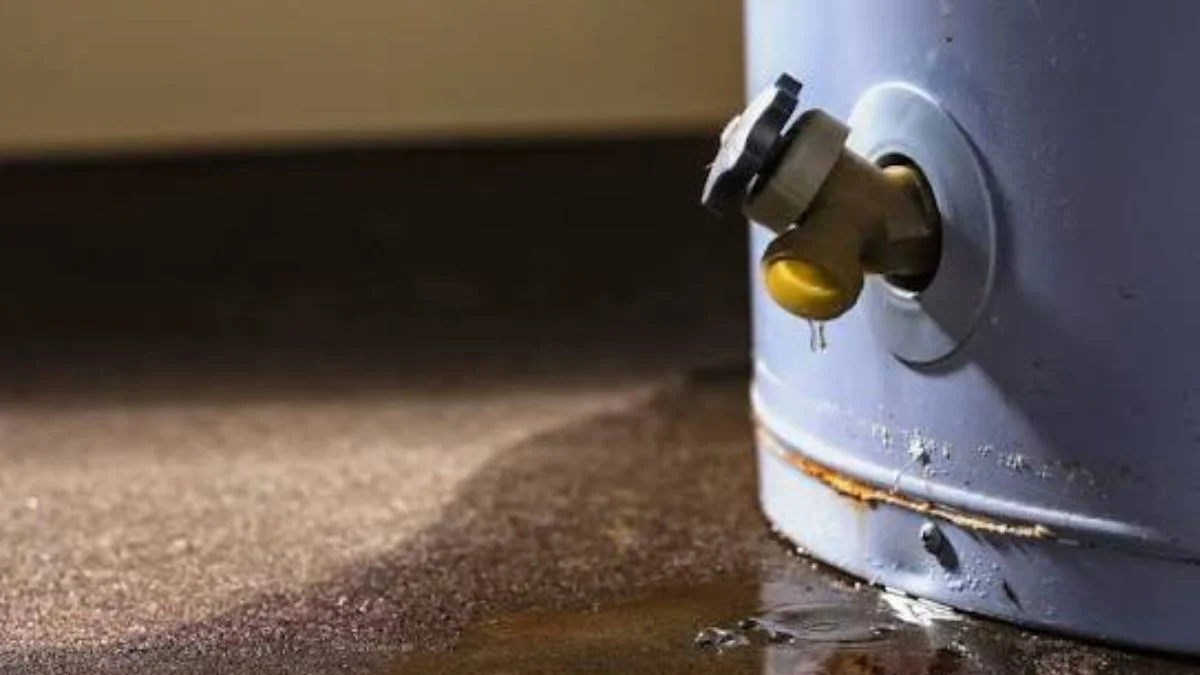
Quick answer: If your water heater is leaking, shut off its power or gas first, then close the cold-water valve on top of the unit. Not every puddle means the tank has failed. Condensation, a loose fitting, or a worn valve can all look like a serious leak. But any active leak needs attention today, not next week, because the longer it runs, the more it can damage your floors, walls, and belongings.
Water Heater Leaking Right Now? Do These Things First
Work through these in order. Don’t skip ahead to “find the source” before the first two steps are done.
- Cut the power or gas. For an electric water heater, go to your breaker panel and switch off the breaker labeled for the water heater. For a gas water heater, turn the gas control valve on the unit to “off.” Do this before you do anything else near standing water.
- Smell gas? Leave, don’t troubleshoot. If you smell rotten eggs or sulfur near the unit, skip every other step. Get everyone and any pets out of the house, don’t touch light switches or anything electrical on your way out, and call your gas utility (Dominion Energy in the Charleston area) or 911 from outside. A gas smell is not a DIY diagnosis situation.
- Close the cold-water supply valve. This is usually a wheel or lever on the cold-water line entering the top of the tank. Turn clockwise until it stops. If you can’t reach it safely, or it won’t turn, shut off your home’s main water supply instead.
- Contain what’s already on the floor. Towels, a shop vac, or a bucket under an active drip buys you time and protects flooring while you sort out the rest.
- Only now, look for the source. With power or gas off and water supply closed, it’s safe to look at connections, valves, and the base of the tank.
- Call a plumber if the leak is active, heavy, or from the tank itself. A slow drip from an accessible fitting might wait until morning. Standing water, a steady stream, or water coming from the tank body itself doesn’t.
Don’t try to disassemble the gas control, the electrical connections, the T&P valve, or any internal tank component yourself. None of that is a homeowner repair, and getting it wrong is a safety risk, not just a cost risk.
If you’re dealing with an active leak and aren’t sure what’s safe to touch, call Pineapple Plumbing at (843) 739-7438. We’ll walk you through the shutoff over the phone and get someone headed your way. Our emergency plumbing team handles active water heater failures throughout Charleston, Summerville, and the surrounding Lowcountry.
How Serious Is This, Really?
Not every leak is an emergency, but every leak deserves a look. Use this to gauge where yours falls.
| What You’re Seeing | Likely Cause | Urgency | What to Do |
|---|---|---|---|
| Damp ring or light moisture on the tank exterior, especially in summer | Condensation from a cold water line meeting a warm tank | Low | Wipe it dry and monitor for 24 hours before assuming it’s a leak |
| Slow, steady drip from a valve or fitting | Loose connection, worn drain valve, or a dripping T&P valve | Moderate | Shut water supply if it’s worsening; schedule a repair this week |
| Continuous water flow or a growing puddle at the base | Tank seam or shell failure | High | Shut off water and power/gas now; call a plumber today |
| Water spraying or shooting from a valve or fitting | Failed valve under pressure | High | Shut off water supply immediately; call a plumber |
| Gas odor near the unit | Possible gas leak | Emergency | Leave the house; call your gas utility or 911 from outside |
| Rust-colored water only from the hot tap | Internal tank or anode rod corrosion | Moderate to high | Have the tank inspected before it progresses to a leak |
First, Make Sure the Water Heater Is Actually the Source
Before you assume the worst, rule out the easy explanations. Water around a water heater doesn’t always come from the water heater.
Condensation. This is the most commonly misdiagnosed “leak,” and it’s genuinely common in Charleston’s humidity. When cold water enters the tank, or when the room air is humid and the tank surface is cooler than the dew point, moisture forms on the outside of the tank and drips down. Water heater manufacturers note that this is especially common in warm, humid locations and can appear around fittings at the top of the tank as well as the base. Here’s a field test you can run yourself: wipe the tank and the floor completely dry, then check back in a few hours without using hot water in the house. If the area is dry, it was condensation. If water has reappeared, you have an actual leak.
Nearby plumbing or HVAC. A condensate line from an air handler, a nearby supply line, or even water traveling down a wall or floor joist from a leak somewhere else in the house can pool near the water heater and look like it’s coming from the unit. If the water heater itself is bone dry when you check it directly, the source is somewhere else, and it’s worth a broader leak detection inspection rather than water heater repair.
Water that traveled. Water heaters aren’t perfectly sealed boxes. A leak at the top of the unit can run down the side of the tank and pool at the base, making a top leak look like a bottom leak. Dry the unit off, then watch where moisture reappears first.
Where Is the Water Actually Coming From?
Once you’ve confirmed it’s the water heater, the location tells you most of what you need to know.
Leaking From the Top
Top leaks are usually the least serious. The most common causes are a loose or corroded connection at the cold-water inlet or hot-water outlet, a fitting that was never fully tightened, or condensation running down from those same connections. A homeowner can often see whether a fitting looks wet or corroded, but tightening a fitting on a pressurized line, especially near hot water, is a job for someone who does it regularly. If the leak is a slow drip at a connection and not from the tank body, this is typically one of the more affordable repairs.
Leaking From the Bottom
This is where homeowners jump to the worst conclusion, and it isn’t always warranted. Water pooling at the base can come from several places: the drain valve, the T&P valve discharge line (which often runs down the side and exits near the bottom), condensation running down the tank, or the tank shell itself. The fact that water shows up at the bottom doesn’t prove the bottom of the tank has failed. It’s the lowest point, so that’s where water collects no matter where it started.
The Drain Valve
The drain valve is the small spigot near the bottom used to flush sediment from the tank. It can drip because the internal washer has worn out, because it wasn’t fully closed after a flush, or because sediment is preventing it from seating properly. A dripping drain valve does not mean the tank has failed. In many cases it’s a valve replacement, not a water heater replacement.
The Temperature and Pressure Relief (T&P) Valve
The T&P valve is a safety device, not a fitting to ignore. It’s designed to open and release water if the temperature or pressure inside the tank rises above a safe level, which prevents a much more dangerous outcome. Occasional discharge can be caused by thermal expansion, which happens when heated water has nowhere to go in a closed plumbing system, especially in homes without an expansion tank. Persistent dripping can also mean the valve itself has worn out or has mineral buildup preventing it from sealing. Either way, a T&P valve should never be capped, plugged, or disabled. If it’s discharging regularly, the cause needs to be diagnosed, not silenced.
The Tank Itself
If water is coming from the tank body, a seam, or a weld, and not from any of the fittings or valves above it, that’s tank failure. Internal corrosion eventually breaks through the steel shell from the inside, and once that happens, there is no permanent repair. A leaking tank means replacement.
Signs the Tank Has Actually Failed
- Water visibly coming from the tank body itself, not a fitting or valve
- Rust or heavy corrosion visible on the tank exterior
- Water continuing to appear after every fitting and valve has been checked and ruled out
- Rust-colored hot water at the tap, suggesting corrosion has already reached the tank walls
- A leak that recurs in the same spot after drying it out
Age alone isn’t proof of failure. A well-maintained unit can still be sound at 8 or 9 years old, and a neglected one can fail earlier. Age combined with one or more of the signs above is what points toward replacement.
Repair or Replace? What Actually Decides It
| Situation | Repair Usually Makes Sense | Replacement Usually Makes Sense |
|---|---|---|
| Loose or leaking fitting/connection | Yes | Rarely |
| Dripping drain valve | Yes | Rarely |
| T&P valve discharging | Cause must be diagnosed first (may be a $25–$150 part) | Only if the tank itself is also compromised |
| Unit under 8 years old, tank not leaking | Yes | No |
| Tank leaking from the body/shell | No, tank leaks can’t be permanently patched | Yes |
| Unit over 10 years old, on its second or third repair | Depends on cost | Usually |
| Repair cost exceeds roughly 50% of a new installed unit | No | Usually |
| Rust-colored hot water indicating corrosion past the anode rod | No | Usually |
A professional diagnosis weighs the exact source of the leak against the tank’s age, condition, and repair history, not just one factor in isolation. That’s the same framework our team applies on the Water Heater Repair & Replacement page, and it’s worth reading if you want the fuller picture on tank life expectancy and what a replacement typically involves.
Can I Keep Using a Leaking Water Heater?
It depends entirely on where the leak is, not on how badly you want a hot shower.
A confirmed, minor drip from an accessible fitting that you’re monitoring and containing can usually wait a day or two for a scheduled repair. Anything beyond that changes the answer. If the tank body is leaking, if the leak is worsening, if there’s any gas smell, or if you’re not certain what’s causing it, don’t keep running the unit. Continuing to fill and heat a compromised tank raises the risk of a bigger failure, and running a gas or electric unit you’re not sure is safe isn’t worth the convenience.
What Happens If You Ignore It?
A slow leak rarely stays slow. Left alone, water heater leaks typically lead to:
- Warped or stained flooring, especially on hardwood or laminate
- Damaged drywall, baseboards, or cabinetry near the unit
- Mold and mildew, which can begin developing within 48 to 72 hours in a humid climate like Charleston’s
- Accelerated corrosion on the tank and nearby connections, which speeds up the eventual failure
- A minor repair turning into a full replacement, or a contained leak turning into a flooded utility closet or garage
None of this requires exaggeration to take seriously. A puddle you can wipe up tonight is a lot cheaper than the water damage restoration project it becomes in a week.
What Will a Plumber Actually Check?
When a professional comes out for a leaking water heater, the visit typically covers:
- Confirming the exact source: fitting, valve, or tank shell
- Checking supply-line and drain-valve connections for looseness or wear
- Testing whether T&P discharge is caused by thermal expansion, high water pressure, or a failing valve
- Inspecting the tank exterior for corrosion, rust, or signs the shell itself is compromised
- Checking household water pressure, since pressure above what the T&P valve is rated for will cause repeat discharge
- Reviewing the unit’s age and repair history against the cost of the repair on the table
- Giving you a straight answer, and a written price, on repair versus replacement before any work starts
What Charleston Homeowners Should Know
A few local factors are worth understanding, and a few common claims aren’t backed by the data.
Charleston’s water is moderately soft, not hard. Charleston Water System’s water quality data puts total hardness at roughly 56 parts per million, or about 3.3 grains per gallon, which falls in the “slightly hard to moderately soft” range, not the aggressive hard-water territory you’ll see claimed on some water-treatment marketing pages. That means sediment buildup happens more slowly here than in genuinely hard-water regions, though it still accumulates over years, particularly in units that have never been flushed.
Humidity is the bigger local factor. Charleston’s warm, humid climate makes condensation around a water heater more common than it would be in a drier climate, which is exactly why the field test earlier in this article matters. Humidity also accelerates corrosion on exterior connections and fittings over time, especially in garages, crawl spaces, and utility closets without climate control, which are common installation spots in Lowcountry homes.
Older housing stock adds variables. Many homes from downtown Charleston to Summerville and Mount Pleasant have older plumbing, tighter utility closets, and water heaters installed in crawl spaces, all of which can make both diagnosis and access more involved than a straightforward garage installation.
Pineapple Plumbing serves homeowners across Charleston, North Charleston, Summerville, Mount Pleasant, West Ashley, James Island, Johns Island, Daniel Island, Goose Creek, and Hanahan, and we see the full range of these setups regularly.
Why Homeowners Call Us for This
Co-owners Austin Holcomb and Austin Webb bring a combined 22 years of hands-on plumbing experience to water heater diagnosis specifically, and the approach doesn’t change based on what’s convenient to sell. If a $25 valve or a $150 part solves the problem, that’s what gets recommended. If the tank itself has failed, you’ll see exactly why before you’re asked to approve a replacement. No manufactured urgency, no guessing, and no bill that looks different from the estimate you approved.
If you’re staring at a puddle right now and want a second opinion on what you’re looking at, call (843) 739-7438. We’ll help you figure out whether this is a five-minute fix or something that needs a same-day visit.
Frequently Asked Questions
Why is my water heater leaking? The most common causes are a loose or worn connection at the top of the tank, a dripping drain valve, T&P valve discharge from thermal expansion or a failing valve, or, in the most serious cases, corrosion that has worked through the tank shell. Condensation is also a common cause that isn’t a true leak at all.
Should I turn off my water heater if it’s leaking? Yes. Turn off the power at the breaker for an electric unit, or turn the gas control to “off” for a gas unit, then close the cold-water supply valve. Doing this first prevents the leak from worsening and removes the risk of the unit continuing to heat while damaged.
Can I still use hot water if my water heater is leaking? Only if the leak is minor, confirmed to be at an accessible fitting or valve, and you’re actively monitoring it. If the leak is from the tank body, worsening, or unidentified, don’t keep using the unit until it’s been checked.
Is a leaking water heater an emergency? It depends on the severity. A slow drip from a valve can typically wait for a scheduled repair. A steady stream, a growing puddle, or any gas odor is an emergency that needs same-day attention.
Why is my water heater leaking from the bottom? Water often appears at the bottom because it’s the lowest point on the unit, even if it started higher up. Common causes include the drain valve, T&P valve discharge running down the side of the tank, condensation, or, if none of those check out, corrosion in the tank shell itself.
Can a leaking water heater be repaired, or does it need to be replaced? It depends on the source. Leaks from a fitting, valve, or connection are usually repairable. A leak from the tank body itself cannot be permanently repaired and means the unit needs to be replaced.
Why is water coming from the pressure relief valve? Usually thermal expansion, high water pressure, or a valve that has worn out and can no longer seal properly. Because the T&P valve is a critical safety device, persistent discharge should be diagnosed by a professional rather than capped or ignored.
Who should I call for a leaking water heater in Charleston? Pineapple Plumbing handles water heater leaks and emergencies throughout Charleston, Summerville, Mount Pleasant, and the surrounding Lowcountry. Call (843) 739-7438 for a same-day assessment of an active leak.


